
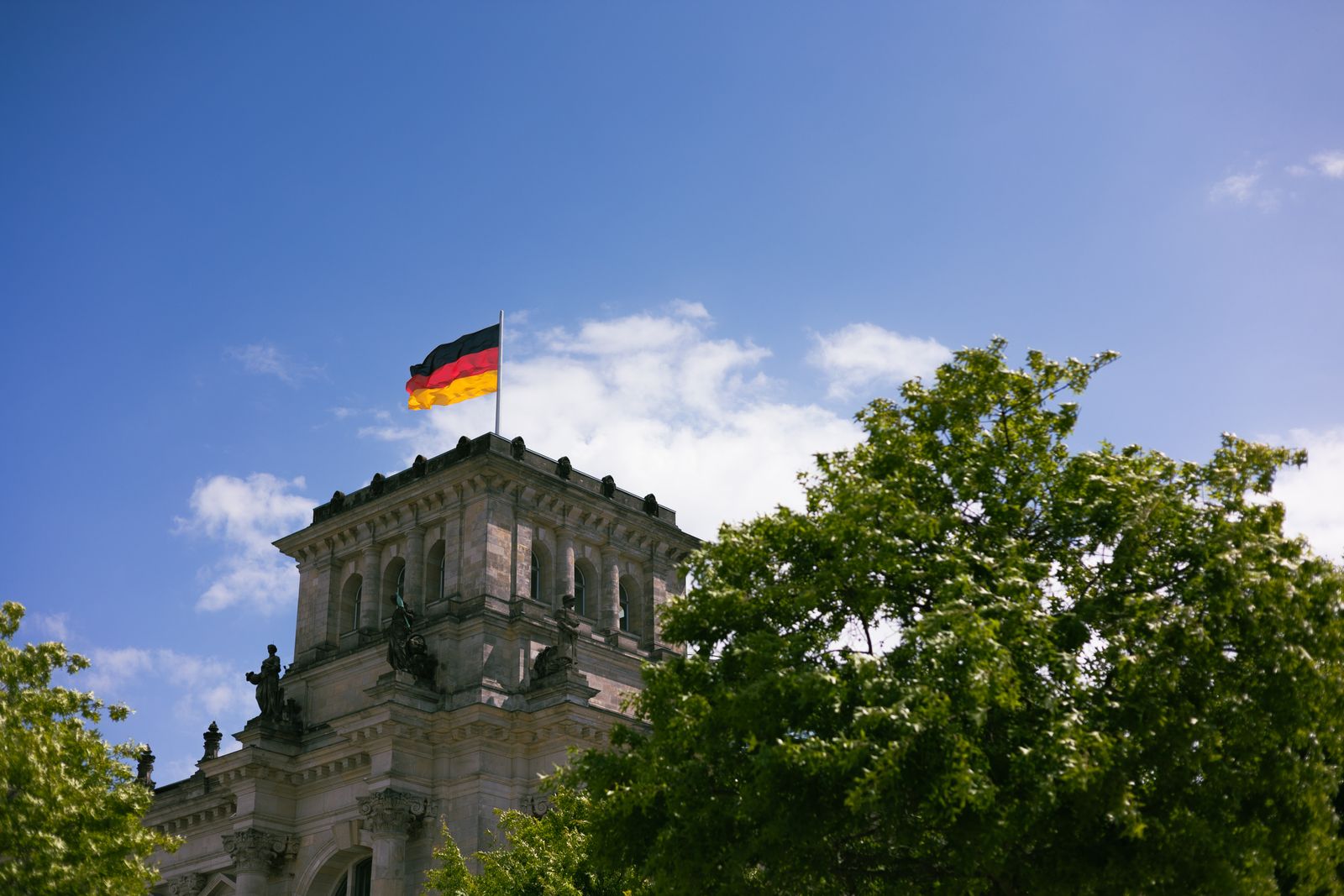
On September 6, Germany's Saxony-Anhalt state parliament election delivered its verdict: the Alternative for Germany (AfD) took 43.8% of the vote — more than double its result five years ago — and came within just three seats of governing alone. Chancellor Merz's Christian Democrats collapsed from 37.1% to 17.1%, the party's worst regional defeat in decades.
Merz's reaction that day came down to a single phrase: "deeply shocked."
The real significance of this news lies in the contrast across time.
For the past decade and more, if you counted up Europe's right-wing governments, you'd notice something interesting: the loudest ones were almost all small countries. Hungary, Poland, Austria — they lacked weight, so the EU could isolate them as "individual cases." No matter how much Orbán raged, the core machinery of Britain, France and Germany kept turning, like a noisy argument at the next table that never reaches yours.
But look closer, and this round's list has completely changed.
Public reports say the countries now turning right at the same time are Britain, France and Germany — the EU's three engines — plus the United States, India and Japan, the world's leading economies, most populous nations and manufacturing powers. These are countries that set the rules, not countries that get ruled.
So when a small country turns right, it's news. When a great power turns right, it's a system-level variable.
1. From "Edge Experiment" to "Core Breakthrough"
Look at the three great powers' hands, and you'll see this isn't a small game.
Germany: the AfD took 20.8% in the February 2025 federal election, doubling its previous result to become the second-largest party and finishing first in all five eastern states. A year earlier, in September 2024, it had won the state election in Thuringia — the first such win since World War II. And this month, 43.8% in Saxony-Anhalt, three seats short of governing alone, leaving the firewall creaking. Worse still, it now ranks second among 18-to-29-year-olds and first among 30-to-44-year-olds. The far right used to run on disaffected middle-aged voters; now it's harvesting the young.
France: the National Rally (RN) took about 31.4% in the June 2024 European Parliament elections, a historic win that forced Macron to dissolve parliament. Le Pen rode a legal roller coaster — barred from office for five years in 2025, only to have the ban cut to fifteen months on appeal in 2026, restoring her eligibility — but her first-round voting intention holds steady at 31% to 36%, comfortably first.
Britain: Reform entered parliament for the first time in July 2024, then led the polls with peaks above 30%, eventually forcing Prime Minister Starmer to resign in June 2026. In British politics, that's a newcomer overturning the whole table.
Britain, France and Germany turning right at the same time — that's a first in postwar Europe.
But across these three great powers, for now the right remains "approaching power" rather than "taking power."
Germany has its "firewall": all traditional parties refuse to govern with the AfD. France's "republican front" keeps blocking the RN. Britain's Reform has never entered government. The only one who has actually taken power is Donald Trump in America.
So the real shock of this round, beyond the possibility of a future "right-wing government," is that the right is dragging the mainstream rightward.
For example: Germany's CDU, to win back voters, has already moved sharply right on immigration. Britain's Labour and Conservative parties are racing to copy Reform's immigration agenda. French center-right voters' "shame" about the RN is fading. The right hasn't taken power, but it's quietly nudging everyone's coordinate axis one notch to the right. That's more hidden and harder to reverse than seizing power — because your opponent isn't fighting it, they're imitating it.
2. Historical Lesson: The Rightward Turn Is Never a Straight Line
This round counts as a "wave" because it follows the fixed rhythm of rightward turns.
First, rightward turns come in waves, not at a steady pace. One wave in the 1930s, another after the 2008 financial crisis, another after the 2015 refugee crisis, and now another pushed by inflation and energy costs. Each wave's trigger is the same: economic anxiety stacked on identity anxiety.
Second, the greatest common denominator is anti-establishment. What the right really sells isn't "left versus right" but "distrust of the mainstream parties, the elite, and transnational institutions." That's why it can pull voters from both the left and the right at once.
Third, a "firewall" can delay but not necessarily stop the tide. Worse, it often forces the traditional center-right to move right itself to win back votes — which is exactly what's happening in Germany, France and Britain right now.
Fourth, power itself is the test. When the right is a protest party, its halo shines brightest; once in government, the anti-establishment halo fades and its governing flaws are laid bare. Hungary's Orbán was crushed 53% by the center-right Tisza party in 2026, ending sixteen years in power. The Netherlands' Wilders was isolated and pushed out of government by mainstream parties. South Korea's Yoon was impeached and removed. Brazil's Bolsonaro was sentenced to 27 years. Winning an election and keeping power are two very different things.
3. Going Global Means Watching Destination Countries' Policy Shifts Closely
After the rightward turn, how does Europe view China? Start with the two most direct lines.
One is importing Chinese goods.
The right's base color is economic nationalism — "buy German, feed Germans." The CDU has long pushed "de-risking," reducing dependence on Chinese supply chains; the AfD is further right and more extreme, even more protective of "made in Germany." Layer on the EU's countervailing duties on Chinese electric vehicles, its tariff investigations into solar panels, and the carbon border tax (CBAM) now phasing in, and the door for Chinese goods into Europe only gets higher year by year. Worse, this isn't something that only happens if the AfD takes power — once the right drags the mainstream rightward, even the traditional center-left no longer dares to be "pro-China." Exports are shifting from a "tariff cost" to a "political cost."
The other is attracting Chinese investment.
Here the attitude is subtler and more divided. The right talks against globalization and against "foreigners buying Germany," yet Germany's deindustrialized eastern states are precisely the ones most desperate for greenfield investment and jobs. So the real attitude is layered: acquisitions (especially of critical infrastructure, chips, ports and energy) face ever-tighter scrutiny, while greenfield plants may actually be welcomed as honored guests. In other words, after the rightward turn, "come buy my assets" gets harder, while "come build a factory and hire my people" may open a crack — depending on which industry and which state you land in.
This is the going-global ledger, worth breaking down item by item:
Dimension one: separate the export account from the investment account. Selling goods into Europe means facing three gates — tariffs, countervailing duties and carbon taxes; these are open cards that only get more expensive. Building a plant in Europe means facing three doors — scrutiny, jobs and localization; these are hidden cards that depend on which state you choose.
Dimension two: the industry decides your fate. EVs, solar, wind, chips and AI are "strategic sectors" watched jointly by the right and the mainstream, where de-risking is fiercest. Consumer electronics, home goods and general industrial products carry low political sensitivity and can still win on value for money. Going global is no longer a question of "whether to go to Europe" but "which list you land on."
Dimension three: security review is a slow knife. The EU's Foreign Subsidies Regulation (FSR) and its foreign investment screening mechanism have tightened year after year; after the rightward turn, these tools will only be used more and harder. The old Chinese playbook of "buy a small target to test the waters" is seeing its window narrow.
Dimension four: localization isn't a bonus, it's an entry ticket. What the right cares about most is jobs and the tax base. Whoever brings jobs, taxes and local supply chains gains a voice; whoever only comes to "sell goods and take profits" becomes a target. Going global used to mean "selling over there"; now it means "growing roots over there."
So for anyone going global, the rightward turn can't be summed up as simply "it got harder." It's a ledger that differs by layer, by industry and by region — some are shut out by tariffs, some squeeze in through greenfield investment, and some are dragged to death by scrutiny because they landed on a sensitive list. Compared to the image of a "unified European market" from five years ago, this is already a different world.
4. So Where Does It Go From Here?
Watch three signals to judge whether this is a "tide" or a "flood":
1. France 2027 — can the RN actually win the presidency; 2. Germany's firewall — will it crack open the first seam (Saxony-Anhalt has already dented it); 3. America 2028 — will MAGA turn from a "movement" into an "establishment."
Break any one of these three, and the nature of the thing changes.
For anyone doing global asset allocation or taking companies abroad, the biggest meaning of this wave is that the coordinate system has changed. Before, you could treat the rightward turn as "noise from marginal countries" and discount it in your decisions; now it's happening in the rule-setting great powers, so you have to treat it as a systemic risk of the core countries and write it into your decision model.
The going-global ledger above is one concrete projection of this new coordinate system onto real business — costs are rising, but windows are opening too. The question is which table you're sitting at.
Now look back at the Middle East. Small as the market is, as a bridge and a base market, its unique advantage will keep existing.
⚠️ Disclaimer: This article reflects personal views and does not constitute investment advice.